domingo, 14 de junho de 2009

Hospitals Begin to Move Into Supermarkets

Hospitals Begin to Move Into Supermarkets
By MILT FREUDENHEIM
Published: May 11, 2009
New York Times

As walk-in clinics at stores like CVS and Wal-Mart offer convenient alternatives to doctors’ offices and hospital emergency rooms, some hospitals are fighting back — with walk-in clinics at some of those same retailers.
round the country, hospitals are now affiliated with more than 25 Wal-Mart clinics. The Cleveland Clinic has lent its name and backup services to a string of CVS drugstore clinics in northeastern Ohio. And the Mayo Clinic is in the game, operating one Express Care clinic at a supermarket in Rochester, Minn., and a second one across town at a shopping mall.

Many primary-care doctors still denigrate the retail clinics as cheap, unworthy competitors. But hospitals see the clinics as a way to reach more patients and expand their business. And they argue that as President Obama and Congress warn of a shortage of primary-care physicians, the hospital-linked retail clinics are filling a vital public need.

The walk-in centers help clear hospital emergency rooms of people seeking only basic medical care, like antibiotics for strep throat. But in contrast to E.R.’s, which in many states cannot legally turn away those unable to pay, the retail clinics typically serve only patients with insurance or money.

And even if $77 throat cultures or $30 physicals do not represent a vast new source of profit for hospitals, retail clinics can play a marketing role, helping establish relationships with customers who may eventually need more lucrative in-hospital care. .......

sábado, 13 de junho de 2009

A Pobreza dos Ricos

*Cristovam Buarque*
Professor da UNB Autor do livro "A desordem do Progresso".

Em nenhum outro país os ricos demonstraram mais ostentação que no Brasil. Apesar disso, os brasileiros ricos são pobres. São pobres porque compram sofisticados automóveis importados, com todos os exagerados equipamentos da modernidade, mas ficam horas engarrafados ao lado dos ônibus de subúrbio. E, às vezes, são assaltados, seqüestrados ou mortos nos sinais de trânsito.
Presenteiam belos carros a seus filhos e não voltam a dormir tranqüilos enquanto eles não chegam em casa. Pagam fortunas para construir modernas mansões, desenhadas por arquitetos de renome, e são obrigados a escondê-las atrás de muralhas, como se vivessem nos tempos dos castelos medievais, dependendo de guardas que se revezam em turnos.

Os ricos brasileiros usufruem privadamente tudo o que a riqueza lhes oferece, mas vivem encalacrados na pobreza social. Na sexta-feira, saem de noite para jantar em restaurantes tão caros que os ricos da Europa não conseguiriam freqüentar, mas perdem o apetite diante da pobreza que ali por perto arregala os olhos pedindo um pouco de pão; ou são obrigados a ir a restaurantes fechados, cercados e protegidos por policiais privados. Quando terminam de comer escondidos, são obrigados a tomar o carro à porta, trazido por um manobrista, sem o prazer de caminhar pela rua, ir a um cinema ou teatro, depois continuar até um bar para conversar sobre o que viram. Mesmo assim, não é raro que o pobre rico seja assaltado antes de terminar o jantar, ou depois, na estrada a caminho de casa. Felizmente isso nem sempre acontece, mas certamente, a viagem é um susto durante todo o caminho. E, às vezes, o sobressalto continua, mesmo dentro de casa.

Os ricos brasileiros são pobres de tanto medo. Por mais riquezas que acumulem no presente, são pobres na falta de segurança para usufruir o patrimônio no futuro. E vivem no susto permanente diante das incertezas em que os filhos crescerão. Os ricos brasileiros continuam pobres de tanto gastar dinheiro apenas para corrigir os desacertos criados pela desigualdade que suas riquezas provocam: em insegurança e ineficiência.

No lugar de usufruir tudo aquilo com que gastam, uma parte considerável do dinheiro nada adquire, serve apenas para evitar perdas. Por causa da pobreza ao redor, os brasileiros ricos vivem um paradoxo: para ficarem mais ricos têm de perder dinheiro, gastando cada vez mais apenas para se proteger da realidade hostil e ineficiente. Quando viajam ao exterior, os ricos sabem que no hotel onde se hospedarão serão vistos como assassinos de crianças na Candelária, destruidores da Floresta Amazônica, usurpadores da maior concentração de renda do planeta, portadores de malária, de dengue e de verminoses. São ricos empobrecidos pela vergonha que sentem ao serem vistos pelos olhos estrangeiros.

Na verdade, a maior pobreza dos ricos brasileiros está na incapacidade de verem a riqueza que há nos pobres. Foi esta pobreza de visão que impediu os ricos brasileiros de perceberem, cem anos atrás, a riqueza que havia nos braços dos escravos libertos se lhes fosse dado direito de trabalhar a imensa quantidade de terra ociosa de que o país dispunha. Se tivesse percebido essa riqueza e libertado a terra junto com os escravos, os ricos brasileiros teriam abolido a pobreza que os acompanha ao longo de mais de um século. Se os latifúndios tivessem sido colocados à disposição dos braços dos ex-escravos, a riqueza criada teria chegado aos ricos de
hoje, que viveriam em cidades sem o peso da imigração descontrolada e com uma população sem miséria.

A pobreza de visão dos ricos impediu também de verem a riqueza que há na cabeça de um povo educado. Ao longo de toda a nossa história, os nossos ricos abandonaram a educação do povo, desviaram os recursos para criar a riqueza que seria só deles,
e ficaram pobres: contratam trabalhadores com baixa produtividade, investem em modernos equipamentos e não encontram quem os saiba manejar, vivem rodeados de compatriotas que não sabem ler o mundo ao redor, não sabem mudar o mundo, não sabem construir um novo país que beneficie a todos. Muito mais rico seriam os ricos se
vivessem em uma sociedade onde todos fossem educados.

Para poderem usar os seus caros automóveis, os ricos construíram viadutos com dinheiro de colocar água e esgoto nas cidades, achando que, ao comprar água mineral, se protegiam das doenças dos pobres. Esqueceram-se de que precisam desses pobres e não podem contar com eles todos os dias e com toda saúde, porque eles (os pobres) vivem sem água e sem esgoto. Montam modernos hospitais, mas tem dificuldades em evitar infecções porque os pobres trazem de casa os germes que os contaminam. Com a pobreza de achar que poderiam ficar ricos sozinhos, construíram um país doente e vivem no meio da doença.

Há um grave quadro de pobreza entre os ricos brasileiros. E esta pobreza é tão grave que a maior parte deles não percebe. Por isso a pobreza de espírito tem sido o maior inspirador das decisões das decisões governamentais das pobres ricas elites brasileiras. Se percebessem a riqueza potencial que há nos braços e nos cérebros dos
pobres, os ricos brasileiros poderiam reorientar o modelo de desenvolvimento em direção aos interesses de nossas massas populares.
Liberariam a terra para os trabalhadores rurais, realizariam um programa de construção de casas e implantação de redes de água e esgoto, contratariam centenas de milhares de professores e colocariam o povo para produzir para o próprio povo. Esta seria uma decisão que enriqueceria o Brasil inteiro? Os pobres que sairiam da pobreza e os ricos que sairiam da vergonha, da insegurança e da insensatez.

Mas isso é esperar demais. Os ricos são tão pobres que não percebem a triste pobreza em que usufruem suas malditas riquezas.

terça-feira, 19 de maio de 2009

Oxalá os veja

sexta-feira, 15 de maio de 2009

no helping hand out here


from European Social Survey

pestinha

porque não?

terça-feira, 5 de maio de 2009

on the future

At any moment we are free to act toward the future we desire.


in Heinz Von Foerster, 1971, "Perception of the Future and the Future of Perception", Twenty-fourth Annual Conference on World Affairs at the University of Colorado, Boulder, Colorado, U.S.A.

on information and knowledge

The primordial and most proprietary processes in any man and, in fact, in any organism, namely “information and “knowledge,” are now persistently taken as commodities, that is as substance. Information is, of course, the process by which knowledge is acquired, and knowledge is the processes that integrate past and present experiences to form new activities, either as nervous activity internally perceived as thought and will, or externally perceivable as speech and movement (Maturana, 1970, 1971; Von Foerster, 1969,1971).
Neither of these processes can be “passed on” as we are told in phrases like “. . . Universities are depositories of Knowledge which is passed on from generation to generation,” etc., for your nervous activity is just your nervous activity and, alas, not mine.
No wonder that an educational system that confuses the process of creating new processes with the dispensing of goods called “knowledge” may cause some disappointment in the hypothetical receivers, for the goods are just not coming: there are no goods.
Historically, I believe, the confusion by which knowledge is taken as substance comes from a witty broadsheet printed in Nuremberg in the Sixteenth Century. It shows a seated student with a hole on top of his head into which a funnel is inserted. Next to him stands the teacher who pours into this funnel a bucket full of “knowledge,” that is, letters of the alphabet, numbers and simple equations. It seems to me that what the wheel did for mankind, the Nuremberg Funnel did for education: we can now roll faster down the hill.
Is there a remedy? Of course, there is one! We only have to perceive lectures, books, slides and films, etc., not as information but as vehicles for potential information. Then we shall see that in giving lectures, writing books, showing slides and films, etc., we have not solved a problem, we just created one, namely, to find out in which context can these things be seen so that they create in their perceivers new insights, thoughts, and actions.


in Heinz Von Foerster, 1971, "Perception of the Future and the Future of Perception", Twenty-fourth Annual Conference on World Affairs at the University of Colorado, Boulder, Colorado, U.S.A.

segunda-feira, 4 de maio de 2009

OqueStrada

Amor à primeira vista:

CD - TascaBeat o sonho português...

nas lojas e no Myspace

campanha eleitoral na sociedade da informação

Date: Mon, 27 Apr 2009 11:51:55 +0100
From:
To:
Subject: Fwd: o que Vital Moreira pensa dos professores


----- Mensagem encaminhada de -----
Data: Mon, 27 Apr 2009 11:16:49 +0100
De:
Assunto: o que Vital Moreira pensa dos professores


"ele é" cada um melhor que o outro! :P

(mas é para votar nele e o mandar para fora do país??) ;)


From: info.maceira-owner@prof2000.pt [mailto:info.maceira-owner@prof2000.pt] On Behalf Of Nuno Silva
Sent: quinta-feira, 23 de Abril de 2009 19:39
To: info.maceira@prof2000.pt
Subject: o que Vital Moreira pensa dos professores
Divulguem junto de todos os professores que conhecem o que Vital Moreira pensa dos professores Vital Moreira, reputado professor de Direito da Universidade de Coimbra, foi, este fim-de-semana, no Congresso do Partido Socialista, dado a conhecer como cabeça de lista deste partido nas próximas eleições para o Parlamento Europeu.
Vital Moreira é uma personalidade com um passado e um presente político conhecido de boa parte dos portugueses. O que, talvez, nem todos saibam é que este mestre de Direito nutre um profundo desprezo pela classe docente, só comparável ao da actual Ministra da Educação.
De facto, em 18 de Novembro de 2008, no jornal "Público", Vital Moreira faz um dos ataques mais rasteiros e mais odiosos que me foi dado ler em todo este processo de luta dos professores contra o actual sistema de avaliação. Que diz aí Vital Moreira? Básicamente quatro coisas, a saber:
a) Que não existe qualquer razão para que os professores não sejam avaliados para efeitos de progressão na carreira,
b) Que os professores não gozam de direito de veto em relação às leis do país, nem podem auto-isentarem-se do seu cumprimento, pelo que não é aceitável qualquer posição que implique resistência à aplicação do actual modelo de avaliação;
c) Que o governo não pode ceder às exigências dos professores, devendo antes abrir processos disciplinares a todos aqueles que ponham em causa a concretização da avaliação dos docentes tal como foi congeminada pelo Ministério da Educação;
d) Que o governo, na batalha contra os professores, deve esforçar-se por chamar a si a opinião pública, isolando, desta forma, a classe docente.
Este é o pensamento de Vital Moreira, onde a sua veia caceteira surge bem expressa. Mas, mais do que isso, este texto, publicado no "Público", revela-nos um verdadeiro guia político da acção do Ministério da Educação contra os professores.
Que cada colega não perca a memória e dê a devida resposta a este senhor nas eleições para o Parlamente Europeu, é o mínimo que está ao nosso alcance.


----- Finalizar mensagem encaminhada -----


Haveria movimento dos professores se não tivesse havido Plano Tecnológico?

domingo, 3 de maio de 2009

Every Day is Exactly the Same


I believe I can see the future
'Cause I repeat the same routine
I think I used to have a purpose
And then again that might have been a dream
I think I used to have a voice
Now I never make a sound
I just do what I've been told
I really don't want them to come around, oh no

Every day is exactly the same
There is no love here and there is no pain
Every day is exactly the same

I can feel their eyes are watching
In case I lose myself again
Sometimes I think I'm happy here
Sometimes - yeah - I still pretend
I can't remember how this all got started
But I can tell you - exactly - how it will end

Every day is exactly the same
There is no love here and there is no pain
Every day is exactly the same

I'm writing on a little piece of paper
I'm hoping someday you might find
I'll hide it behind something
They don't look behind
I am still inside here
A little bit comes bleeding through
I wish this could have been any other way
I just don't know what else I can do

Every day is exactly the same
There is no love here and there is no pain
Every day is exactly the same

And I've rehearsed my lines
And I know what's coming next


Nine Inch Nails
With Teeth

sexta-feira, 1 de maio de 2009

Trabalho de casa

Ficha de tpc, 1º ano do 1º ciclo:


Ordena as palavras e forma frases:

- vai de O mota Gaspar até vila à

- duas horas. A acabou festa às

- Paulino. fisga é do Esta

- está Neste bosque escuro. muito

- Houve rusga uma bairro. no

Reality Show

quarta-feira, 29 de abril de 2009

Isto parece normal mas não é...

Gripe suína aumenta faturamento de empresas
Yahoo Notícias

PARIS (AFP) - O risco de pandemia de gripe suína suscita preocupação em todo o mundo, mas também aumenta o faturamento de algumas empresas, sobretudo as que fornecem máscaras e luvas esterilizadas.
PUBLICIDADE

Na Ásia e na Europa, as consequências da epidemia de gripe suína podem se revelar benéficas para algumas atividades.

Na Bolsa suíça, o gigante farmacêutico Roche foi um dos raros títulos a registrar uma valorização (+1,38%, a 146,50 francos), graças ao aumento potencial das vendas de sua vacina Tamiflu, eficiente contra a gripe suína. Contudo, o grupo ainda não recebeu qualquer demanda da Organização Mundial da Saúde (OMS) para disponibilizar seus estoques de antigripal.

Na Bolsa de Londres, o grupo britânico GlaxoSmithKline (GSK), que produz o antigripal Relenza, perdeu 1,48%, estabelecendo-se a 1.048 pence. Já na Bolsa de Kuala Lumpur, as ações dos fabricantes de luvas de látex Top Glove e Latexx ganharam, respectivamente, quase 12% e 8,8% na segunda-feira. Hoje, o título da Latexx subiu mais 8,8%.

"Os investidores apostam nesses fabricantes de luvas porque estão convencidos de que eles vão se beneficiar com a pandemia, como foi o caso em 2003", comentou um corretor na Bolsa da Malásia.

A Ásia ainda está traumatizada com a crise da pneumonia atípica (SRAS) que surgiu em novembro de 2002 na província chinesa de Guangdong (sul) antes de deixar mais de 800 mortos em todo o mundo, 350 deles na China.

No mesmo ano, o vírus altamente patogênico da gripe aviária, o H5N1, apareceu na Ásia e matou mais de 250 pessoas, a maioria no sudeste asiático.

Na Bolsa de Sydney, as ações do laboratório Rockeby Biomed, que desenvolveu um "teste rápido" da gripe A (da mesma família que a gripe suína), aumentaram 78% somente nesta terça-feira.

Os investidores "compraram com convicção", observou Chris Weston, analista da IG Markets.

"Os títulos das empresas que dependem da evolução da situação sanitária aumentaram muito", acrescentou.

Assim, as ações da companhia farmacêutica Biota recuaram 3,2% nesta terça-feira, mas unicamente por causa das tomadas de benefícios depois de ter registrado na véspera um aumento de quase 80%.

Na China, os investidores também se voltaram para empresas farmacêuticas ou ligadas à saúde animal, suscetíveis de lucrar com a epidemia de gripe suína.

O título da China Animal Husbandry Industry, que fabrica produtos para a saúde animal, ganhou mais de 5% nesta terça-feira, depois de subir 10% na véspera.

A empresa farmacêutica Inner Mongolia Jinyu Group também registrou uma alta de 10% na segunda-feira.

Na Índia, o Cipla, que produz a versão genérica do antiviral Tamiflu, se disse nesta terça-feira disposto a fornecer 1,5 milhão de doses. Cipla e o outro laboratório indiano, Ranbaxy, já tinham fornecido antiviral a vários países asiáticos durante a epidemia de gripe aviária em 2006.


É repugnante que existam ser humanos a investir nisto
É também repugnante que os jornais observem sob esta perspectiva como se fosse normal
Quanto mais será justificado com a crise?

domingo, 26 de abril de 2009

temos os que merecemos

Mas o pior é mesmo o preâmbulo do email em que a noticia circula. não se percebe bem a lógica mas percebe-se a intenção.


----- Original Message -----
From:
To: undisclosed recipients
Sent: Sunday, April 26, 2009 8:57 PM
Subject: Fwd: Alunos de Penacova condenados por se manifestarem contra o estatuto do aluno


Alunos de Penacova condenados por se manifestarem contra o estatuto do aluno

Meus amigos, esta situacao so sera possivel em estados tiranicos do terceiro Mundo ou num pequeno pais europeu (que por estas e por outras possivelmente devia ter ficado preso a Africa e nao a Europa), (des)Governado por um Primeiro Ministro JOSE SOCRATES.

Salazar, volta que esta perdoado e ve la se ainda consegues limpar o pais de toda esta merda que por aqui anda...

E depois admiram-se que o suposto maior tirano portugues do seculo seja eleito a figura publica mais prestigiada pelo portugueses... pudera, com governos destes!


---------- Forwarded message ----------
From:
Date: 2009/4/22
Subject: Alunos de Penacova condenados por se manifestarem contra o estatuto do aluno
To:


Exmos. Senhores

Em anexo um comunicado da Associação de Pais e Encarregados de Educação de Penacova a propósito da condenação de três alunos, por... participação em manifestação contra o estatuto do aluno! Segue também cópia da sentença, onde apagámos os nomes, a pedido dos seus pais.
Agradecemos a V. melhor atenção e toda a divulgação que o assunto e anossa indignação merece.

Com os melhores cumprimentos,

25 de Abril de 2009

Três alunos de Penacova cumprem serviço comunitário após manifestação na escola
23.04.2009 - 00h14 André Jegundo
in Público

Três alunos da Escola Secundária de Penacova vão cumprir 20 horas de serviço comunitário por terem tentado encerrar a escola a cadeado durante uma manifestação contra o Estatuto do Aluno, em Novembro passado.

Os estudantes, agora com 18 anos de idade, foram constituídos arguidos pela eventual prática do crime de coacção e por proposta do Ministério Público (MP), com a concordância dos próprios, vão prestar serviço comunitário de modo a evitar uma possível acusação e condenação. Contudo, os pais e a associação de encarregados de educação da escola estão “indignados” e dizem que os estudantes “sofreram na prática uma condenação”.

Por proposta do MP de Penacova, e com a concordância de uma juíza de instrução criminal, o processo de que os estudantes são alvo foi suspenso durante quatro meses e as 20 horas de “serviço de interesse público” devem ser prestadas “no estabelecimento de educação onde foram praticados os factos”, refere o despacho do MP. Ao mesmo tempo, os três jovens vão ser acompanhados pelo Centro de Observação e Acção Social de Coimbra, onde ontem marcaram presença pela primeira vez.

O caso remonta a 17 Novembro do ano passado, quando Fábio, Gonçalo e Eduardo se preparavam para encerrar o portão da escola a cadeado no dia de uma manifestação contra o Estatuto do Aluno. Uma patrulha da GNR que se encontrava no local impediu-os de encerrar a escola e os estudantes acabaram por ser identificados. “Não chegámos a colocar o cadeado porque a GNR falou connosco e disse-nos que, se o fizéssemos, poderíamos ter problemas”, refere Gonçalo.

Depois de ter identificado os estudantes, a GNR elaborou um auto da ocorrência que foi enviado para o MP. “Os miúdos foram posteriormente chamados a prestar declarações no Ministério Público e foi então que tiveram conhecimento de que estavam indiciados pela eventual prática do crime de coacção por terem tentado encerrar a escola”, revela Patrícia Luís, advogada de um dos estudantes. Os pais dos alunos não compreendem por que razão os estudantes foram envolvidos no processo mesmo não tendo encerrado a escola, mas a advogada lembra que o crime de coacção é punível “também na forma tentada”.

Os advogados que representam os estudantes aconselharam-nos a aceitar a proposta de suspensão do processo formalizada pelo MP de modo a evitar uma eventual acusação. Ilda Simões, advogada de dois dos estudantes, defende que esta foi a “melhor forma” de terminar o processo. “Julgo que é uma forma didáctica de lhes mostrar que têm o direito de se manifestar e de fazer greve mas que não podem impedir os outros de entrar na escola, como pretendiam naquele dia”, defende. Opinião diferente têm os pais dos alunos, que dizem não compreender por que razão os estudantes têm de cumprir serviço comunitário se “não praticaram qualquer crime”. Paula Bernardes e Pedro Santo, mãe e pai de dois dos alunos envolvidos, defendem que o caso devia ter sido resolvido “dentro da escola, no âmbito de um processo disciplinar e não através de um processo judicial”, posição defendida pela associação de pais da escola que ontem emitiu um comunicado a criticar a actuação da justiça.

Também ontem a Confederação Nacional Independente de Pais e Encarregados de Educação (CNIPE) “condenou” a situação em que os três estudantes estão envolvidos, defendendo que se trata de um caso “grave, que atenta contra a liberdade de expressão”. “Estão a ser tratados como verdadeiros delinquentes e não são”, declarou Maria José Viseu, presidente da CNIPE

sexta-feira, 24 de abril de 2009

Religião e alterações climáticas não combinam?!

Just what is it with evangelical Christians and global warming?
Leo Hickman
guardian.co.uk, Friday 17 April 2009

The poll canvassed views on climate change among the "major religious traditions" in the US. Surprise, surprise, it shows that "white evangelical Protestants" were the group with the lowest level – 34% of those surveyed – of acceptance that there is solid evidence that global warming is real and that it is attributable to humans. This compares with 47% of the total US population (still startlingly low), and 58% of those surveyed who "had faith" but who were unaffiliated to any particular religious tradition.
...
But I think the We Get It! declaration makes better sense when you learn that it is backed by the Family Research Council and its spokesperson Tony Perkins (no, not the one in Psycho – I think) who says that "we cannot justify policies that make food and energy more expensive on the grounds that we're fighting against an environmental threat that is at best speculative". (Head over to the "issues" page of the Family Research Council for a sample of its other viewpoints – its views on homosexuality are pretty enlightening.)

quinta-feira, 23 de abril de 2009

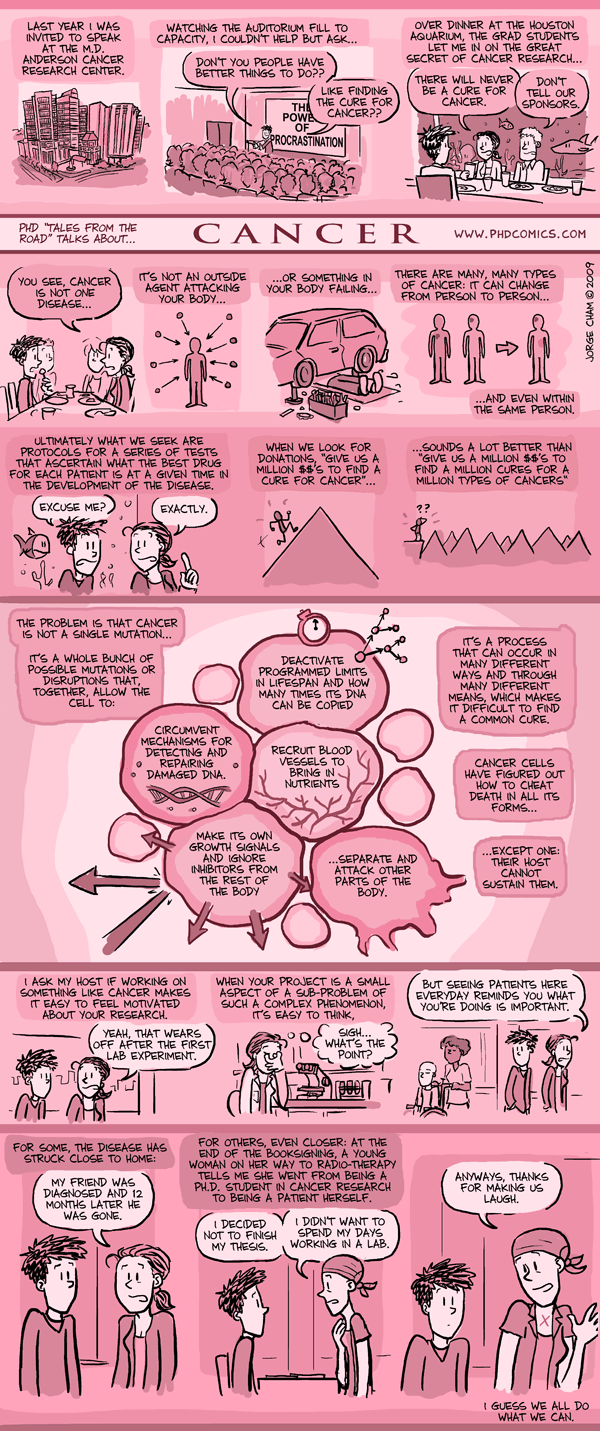
muito sério e comovente


in PhD Comics

segunda-feira, 20 de abril de 2009

(sigh)


copos

“No Booze? You May Lose: Why Drinkers Earn More Money Than Nondrinkers” Bethany L. Peters and Edward Stringham, Journal of Labor Research, vol. 27, no. 3, Summer 2006, pp. 411–21

from Improbable Research

sábado, 18 de abril de 2009

coerência

Um texto de um professor de física despedido por dar A+ a todos os estudantes.

Education for More Anarchy
by Denis G. Rancourt (Professor of Physics, University of Ottawa)

Education should not create experts. It should make experts irrelevant.

“[we call for] full education, all-round education, and complete education, so that no class may exist above [the masses of the people] superior by its knowledge, so that the aristocracy of the intellect may protect and direct them – that is, exploit them. We say that this so-called aristocracy of the intellect is the most hateful, scornful, insolent, and oppressive of all the aristocracies that have, each in its
turn and sometimes all at once, oppressed human society.”
- Bakunin, The Hypnotizers (~1870)

Call it “the knowledge economy” and believe that patents are something other than capital’s tax on the commons of creativity – that patents are something other than contracts for exploitation of the militarily-contained Third World, and of the First World citizenry (e.g., pharmaceuticals) and of everything. Or call it “economics” and believe that it is something other than a religion of wage slavery and capitalist
exploitation. Or call it modern medicine and believe that it has something to do with health rather than sustaining sickness and its profits.
And on
and on.

Institutionalized education brings us into The Lie, that we may serve the
master and not rebel. We are taught that the “power of ideas” must substitute revolutionary action, that mind-masturbation in elite circles will free humanity from injustice.

Bakunin sees the purpose of all-round education as making an individual who “grasps more fully the nature of his surroundings because he better understands those facts which are called the laws of nature and society and which interconnect natural and social events – that that person will feel freer in nature and society […]”
- Bakunin, All-Round Education (~1870)

By contrast, my learned colleagues expound that the masses of the people should “learn more science” but their clear intent is to make them more receptive to the authority of the expert scientists, who themselves are specialized into unquestioning servitude.

My colleagues confuse “freer in nature and society” with “more able to integrate the hierarchy of relative advantages.” They confuse freedom and servitude. They confuse independent thought and ass-licking (to use a biological term).

There are two kinds of “education”: all-round education that frees the human spirit and indoctrination. In our modern plutocracies, the latter is dispensed by the state, in the service of the capital masters and is achieved by the perfected devices of the grades carrot-and-stick (regurgitation on demand) and mindless specialization. In this scheme, “critical thinking” means seamless indoctrination, total assimilation of the master’s ideology.

All-round education cannot be achieved by a series of parallel classrooms in which academic subjects are disciplinally detached from each other and from student realities. However, such a scheme is by design perfect for disrupting natural thought and development patterns, disallowing discourse, and instilling Pavlovian responses to segmented technical abilities to serve capital.

All-round education requires freedom and makes more freedom. All-round education requires relevance and involvement, not forced abstraction and detachment, and creates more relevance and involvement.
Apathy and cynicism are the natural outcomes of state education, which produces infantile consumers, atomized automatons, and service intellectuals at the highest levels. Fortunately, the system is only near-perfect. Nature has a way of preserving itself.

Fight the system or be neutralized. Take back your life.


Existe uma petição para a sua reintegração, mas não será contraditória com o espírito do texto?!

quarta-feira, 8 de abril de 2009

Albert Einstein's Theory of Relativity In Words of Four Letters or Less

[ 0 ]

So, have a seat. Put your feet up. This may take some time. Can I get you some tea? Earl Grey? You got it.

Okay. How do I want to do this? He did so much. It's hard to just dive in. You know? You pick a spot to go from, but soon you have to back up and and go over this or that item, and you get done with that only to see that you have to back up some more. So if you feel like I'm off to the side of the tale half the time, well, this is why. Just bear with me, and we'll get to the end in good time. Okay?

Okay. Let's see....

quinta-feira, 2 de abril de 2009

MOBA


The Museum Of Bad Art was founded the night Scott Wilson pulled this painting from a trash pile on a Boston street. It is the cornerstone upon which the entire institution was built.

terça-feira, 24 de março de 2009

LIFE no Google


O Google imagens tem agora integrado o arquivo fotográfico da LIFE

sábado, 21 de março de 2009

Boa, Obama!

Família Obama vai plantar uma horta biológica nos jardins da Casa Branca
20.03.2009 - 16h21 Helena Geraldes
in Público Online

A família Obama vai plantar no jardim da Casa Branca brócolos, alfaces, ervilhas, cebolas e espinafres, uma horta biológica ao cuidado do próprio pessoal da Casa Branca, noticiou hoje a imprensa americana. A primeira-dama, Michelle Obama, quer promover hábitos saudáveis junto das crianças.

A “primeira semente” será lançada hoje, numa cerimónia que terá como anfitriã Michelle Obama e onde participarão alunos da Escola Primária de Bancroft, noticia o “Washington Post”. Estes continuarão a ajudar a plantar as sementes e a colher os vegetais.

“Estamos a trabalhar num novo e maravilhoso projecto para o jardim”, contou Michelle Obama à revista “O”, de Oprah Winfrey, edição de Abril.

“Queremos usá-lo como instrumento de educação, para falar sobre a saúde e que delicioso é comer alimentos frescos, como os podemos colher e torná-los parte de uma dieta saudável”, acrescentou.

Os talhões para os 55 tipos de vegetais serão plantados na parte Sul dos terrenos da Casa Branca. Katie McCormick Lelyveld, porta-voz da Casa Branca, garantiu que toda a família Obama vai estar envolvida nos trabalhos da horta. Apesar de a manutenção dos jardins ser da responsabilidade do Serviço Nacional de Parques, a horta será plantada e cuidada pela própria Casa Branca. Desta horta deverão sair vegetais e ervas aromáticas para a família e convidados.

Além dos legumes, haverá morangos, ervas aromáticas e duas colmeias, entregues aos cuidados de um carpinteiro da Casa Branca que também é apicultor.

As sementes serão orgânicas, assim como os fertilizantes e repelentes de insectos.

Segundo o “Washington Post”, há dez anos que vários movimentos pedem uma horta biológica no jardim da Casa Branca. “Nada poderia ser mais entusiasmante”, comentou Alice Waters ao jornal. Waters é “chef” do restaurante Chez Panisse, em Berkeley, Califórnia, e que desde a primeira administração Clinton pede uma horta na Casa Branca.

Mas a horta dos Obama não será a primeira na Casa Branca. O Presidente John Adams (1797 – 1801) plantou uma em 1800. Em 1918, Woodrow Wilson (1913 – 1921) levou ovelhas para fertilizar os relvados da Casa Branca e conservar recursos num palco de guerra. Em 1943, Eleanor Roosevelt plantou um jardim da vitória, inspirando milhões de norte-americanos a plantar os seus próprios alimentos durante e Segunda Grande Guerra.

Os esforços recentes têm sido mais modestos, conta o jornal. Jimmy Carter, em 1978, recusou os pedidos para a plantação de uma horta. Nos anos Clinton foi plantada uma pequena horta no telhado da Casa Branca, tendo sido rejeitada a ideia de uma horta nos jardins por alterar a concepção formal dos terrenos.

sexta-feira, 20 de março de 2009

Obscurantismo na ciência

Obscurantism in science has often be come a goal in itself. But it is not enough to confuse the reader; one has to know what it is that one intends to confuse the reader about.

Alexander Kohn, um dos fundadores do Annals of Improbable Research e dos Ig Nobel Prizes

O Artigo completo deve ser lido aqui:
Alexander Kohn “Principles and Methods of Obscurantism,” CA Cancer J Clin, 1970;20;360-364.

quinta-feira, 19 de março de 2009

this scam email is really fun

Note the international moNItary fund, lol


INTERNATIONAL MONITARY FUND
External Review Committee on
Debt Statistics Andfund audit
Balance DebtIMF-World Bank
Collaboration.


Attention: Beneficiary,
Following the protest of the United Nations,The World Bank and IMF,that all outstanding foreign debts especially compensations,Lottery, next of kin,contract payments and online transfer should be released to the beneficiaries forthwith unconditionally from transactions with any Mortgage & Finance institutions in European and African countries.
And also the lost of reasonable amount of cash and properties as a result of Scams Artists, Hurricane Wind,Tornado,Earth Quakes Flood and Oil Spillage & others,United Nations Rehabilitation department is now paying victims that suffered from any of those hard luck in accordance with the U.N-recommendations.The International Community has approved the payment,


This development was a result of new payment policy revolution of 2009,carried out by the WorldFinancial Body in collaboration with World Bank Audit unit and United Nations Policy maker, unit under world bank new year payment constitution.This effort is to help the international monitary fund restrict and monitor
every international transaction to avoid money laundering activities and will help us to fight against fraudulent activities from scam experts.


Furthermore you are advice to reconfirm you billing address including (1)FullName..(2)Contact:Homeor Office-Address..(3)Phone AndFax#.. (4)Your age and current occupation...Attach Copy ofyour Identification to the Euro Finance Investment Bank for the issueing of certified ATM Credit Card,the contact information is as follows:


EURO FINANCIAL BANK ACCRA,REPUBLIC OF GHANA
xxxxxxxxxxxxxxxxxxxxxxxxxxxxxxxxxxxxxxx
E-mail: xxxxxxxxxxxxxxxx@accountant.com
Or xxxxxxxxxxxxxxx@aim.com
TELE/FAX+xxxxxxxxxxxxxxx
NAME:Mr:Gary Smith


NB:Note that you can only withdraw just $20,000.00 per day till your fund is completed.Please do not reply to this E-mail contact the Bank immediately with the necessary information required from you so that they will commence on proceeding.Once again,I apologize toyou on behalf Of IMF(International MonitaryFund)failure to pay your funds in time,which according to records inthe system had been long overdue.

Yours sincerely,
Mr.Koffi Edward

sexta-feira, 13 de março de 2009

indecências

Lista dos mais ricos do Mundo inclui um traficante de droga

Bill Gates, fundador da Microsoft, voltou a ser o homem mais rico do Mundo, com uma fortuna de 40 mil milhões de dólares, divulgou hoje a revista Forbes que, pela primeira vez, integra um traficante de droga da sua lista. É o mexicano Joaquín Guzmán Loera, com uma fortuna de mil milhões de dólares.

Joaquín Guzmán Loera, líder do cartel de Sinaloa, "é um dos maiores traficantes de cocaína dos Estados Unidos", afirmou a coordenadora do estudo, Luísa Kroll, que durante a apresentação sublinhou ainda que as autoridades dos EUA oferecem cinco milhões de dólares de recompensa pelo narcotraficante, cuja "situação financeira é bastante boa".

Conhecido como "El Chapo" Guzmán, o traficante mexicano é um dos 38 novos rostos a figurar nesta selecta lista, em que estão representados mais de 50 países e que, para ser seleccionado, cada um dos magnatas tem de ter pelo menos mil milhões de dólares.

Segundo a revista Forbes, Bill Gates, fundador da Microsoft, voltou a ser o homem mais rico do mundo, com uma fortuna de 40 mil milhões de dólares (31.2 mil milhões de euros), apesar da crise económica global que reduziu o número de milionários do planeta.
"Não é uma surpresa que os milionários tenham sido afectados pela economia mundial", disse hoje Steve Forbes, presidente e conselheiro delegado da revista Forbes.

Lista dos mais ricos passa de 1.125 para 793 nomes

No ano passado, Bill Gates estava no terceiro lugar do clube dos multimilionários, tendo perdido 18 mil milhões de dólares (14 mil milhões de euros) de um ano para o outro, sobretudo devido à desvalorização de 45 por cento das acções da Microsoft.

Warren Buffet, com 37 milhões de dólares (28.9 mil milhões de euros), perdeu a liderança que tinha em 2008, depois dos 13 anos em que Gates se manteve na primeira posição.

Buffet perdeu 25 mil milhões de dólares (19.5 mil milhões de euros) e é o segundo homem mais rico do mundo.

O empresário mexicano Calos Slim Helu, com uma riqueza de 35 mil milhões de dólares (27.3 mil milhões de euros), ocupa a terceira posição do clube dos mais ricos do mundo.

Em quarto lugar está o estudante norte-americano Lawrence Ellison, co-fundador e conselheiro da Oracle, com uma riqueza de 22.500 milhões de dólares (17.6 mil milhões de euros).

O quinto homem mais rico do planeta é o sueco Ingvar Kamprad, com 22 mil milhões de dólares (17 mil milhões de euros), fruto do negócio da companhia de mobiliário e acessórios para a casa Ikea.

A lista dos multimilionários de 2009 é composta por 793 empresários, sendo que no ano passado a lista tinha 1.125 nomes.

Lusa

noticia, e não fotos, retirada de SIC Online

... diluída a fronteira entre a "riqueza legal" e a "riqueza ilegal" está toda do mesmo lado.

quinta-feira, 12 de março de 2009

sábado, 7 de março de 2009

muito interessante...

Free Software and Beyond
The World of Peer Production
4th Oekonux Conference
in cooperation with
P2P Foundation

March 27th-29th, 2009
University of Manchester
http://www.oekonux-conference.org/


Invitation

Project Oekonux researches the economical, political and social forms of Free Software and similar forms of production we collectively call peer production. In Project Oekonux, different people with different reasons and different approaches get together to build something new. A lot of participants want to know, whether and if so, how, the peer production can serve as a basis for a new society.

For the 4th Oekonux Conference Project Oekonux cooperates with the P2P Foundation. The Foundation for Peer to Peer Alternatives researches, documents and promotes P2P practices in every domain of social life. It's a global cyber-collective and aims to be a knowledge and internetworking platform for open/free, participatory, and commons-oriented initiatives on a global scale.

During the past decade the phenomenon of Free Software has become successful and well-known. It is still amazing how in the realm of software the creativity of so many volunteers leads to products which are useful for the whole mankind. Ten years after Project Oekonux was founded the world has changed. As expected by us the principles of the development of Free Software are spreading out to other fields. Wikipedia and Open Access are two of the most interesting examples among many. It is time to look at peer production from a broader perspective.

The 4th Oekonux conference "Free Software and Beyond. The World of Peer Production" takes up this development and widens the perspective from Free Software to other fields of peer production. Project Oekonux and P2P Foundation are proud to welcome nearly 30 invited contributors which will share their experience, studies and insights with us on the following topics

* Peer production beyond Free Software
+ Free Design of material goods for less industrialized countries
+ Open Source Car
+ Free Science with Open Access
+ Open Street Map project
+ Peer production in art
+ Free Farming
+ Free Knitting
* Aspects of Free Software
+ Free Software in Latin America
+ Innovation in Free Software
+ "Others" in the community
+ Communities and single developers
+ Women in Free Software
* Peer production and social movements
+ The Hipatia project
+ Social movements and peer production
+ Indigenous movements and cyberspace
* Theories on peer production
+ Patterns in peer production
+ Market and peer production based economies
+ Peer production and the concept of truth
+ Organization in peer production
* Future of peer production
+ Current limitations of peer production
+ Money and peer production
+ Ideas for expanding peer production
+ Political scenarios for expanding peer production

Please see the program page for detailed information and some more contributions.
Please register for free: http://www.oekonux-conference.org/registration.html


Web-Site: http://www.oekonux.org/

sexta-feira, 6 de março de 2009

Zum-Pim-Zim! (Banquete Aerofuturista)


Jantar-teatro, no âmbito da semana cultural da UC, do encenador e chef belga da companhia Laika, Peter de Bie, com os actores: Michiel Soete, Miguel Moreira, Catarina Requeijo, Sandra Rosado, Sofia Pimentão. Servido pela Escola de Hotelaria e Turismo de Coimbra e o Hotel Astória.

Para rematar, o aperitivo foi o livro NEGREIROS-DANTAS. UMA PÁGINA PARA A HISTÓRIA DA LITERATURA NACIONAL. COIMBRA MANIFESTO 1925, (Fenda).

The Idealist.org Handbook for Building a Better World


Esta noção de "fazer a diferença" intriga-me cada vez mais.

quinta-feira, 5 de março de 2009

quarta-feira, 25 de fevereiro de 2009

consciência pesada

Charities ride Slumdog wave
By Kaye Wiggins, Third Sector Online, 24 February 2009


Surge in donations for organisations working with street children in India

Charities working with street children in India have seen a surge in interest from new donors after the success of Slumdog Millionaire.

The film, which tells the story of a boy from the slums who appears on the Indian version of Who Wants to be a Millionaire?, won eight Academy Awards this week.

Terina Keene, chief executive of street children's charity Railway Children, said the charity had been inundated with calls.

"The phone doesn't stop ringing," she said. "In the past three days more than 1,500 people have visited our website. There are normally about 150 visitors per day."

In response to the film's success, the charity has placed an advert on internet search engine Google for the first time, she said.

Keene also said Slumdog actor Dev Patel and director Danny Boyle were in talks to appear on the English version of Who Wants to be a Millionaire? to raise funds for Railway Children.

Orphan charity SOS Children's Villages also said it had attracted new donors since the film was released.

Andrew Cates, chief executive of the charity, said: "Raising the issue of street children is an enormous benefit to us. Since Slumdog Millionaire, we've attracted more sponsorships for India than we usually do."

Save the Children said it had also benefited from Slumdog's success. A spokeswoman said: "People have been talking about the issues the film raises and then signing up as donors."

quinta-feira, 19 de fevereiro de 2009

NYU BUILDING TAKEOVER!!!

****FOR IMMEDIATE RELEASE******

please forward far/wide!

NYU BUILDING TAKEOVER!!!
At approximately 10pm tonight (Feb. 18), students of Take Back NYU! took over the Kimmel Marketplace. They have blockaded the doors and declared an occupation! They presented their demands to the NYU administration. They read as follows:
DEMANDS
We, the students of NYU, declare an occupation of this space. This occupation is the culmination of a two-year campaign by the Take Back NYU! coalition, and of campaigns from years past, in whose footsteps we follow.
In order to create a more accountable, democratic and socially responsible university, we demand the following:
1. Full legal and disciplinary amnesty for all parties involved in the occupation.
2. Full compensation for all employees whose jobs were disrupted during the course of the occupation.
3. Public release of NYU's annual operating budget, including a full list of university expenditures, salaries for all employees compensated on a semester or annual basis, funds allocated for staff wages, contracts to non-university organizations for university construction and services, financial aid data for each college, and money allocated to each college, department, and administrative unit of the university. Furthermore, this should include a full disclosure of the amount and sources of the university's funding.
4. Disclosure of NYU's endowment holdings, investment strategy, projected endowment growth, and persons, corporations and firms involved in the investment of the university's endowment funds. Additionally, we demand an endowment oversight body of students, faculty and staff who exercise shareholder proxy voting power for the university's investments.
5. That the NYU Administration agrees to resume negotiations with GSOC/UAW Local 2110 – the union for NYU graduate assistants, teaching assistants, and research assistants. That NYU publically affirm its commitment to respect all its workers, including student employees, by recognizing their right to form unions and to bargain collectively. That NYU publically affirm that it will recognize workers' unions through majority card verification.
6. That NYU signs a contract guaranteeing fair labor practices for all NYU employees at home and abroad. This contract will extend to subcontracted workers, including bus drivers, food service employees and anyone involved in the construction, operation and maintenance at any of NYU's non-U.S. sites.
7. The establishment of a student elected Socially Responsible Finance Committee. This Committee will have full power to vote on proxies, draft shareholder resolutions, screen all university investments, establish new programs that encourage social and environmental responsibility and override all financial decisions the committee deems socially irresponsible, including investment decisions. The committee will be composed of two subcommittees: one to assess the operating budget and one to assess the endowment holdings. Each committee will be composed of ten students democratically elected from the graduate and under-graduate student bodies. All committee decisions will be made a strict majority vote, and will be upheld by the university. All members of the Socially Responsible Finance Committee will sit on the board of trustees, and will have equal voting rights. All Socially Responsible Finance Committee and Trustee meetings shall be open to the public, and their minutes made accessible electronically through NYU's website. Elections will be held the second Tuesday of every March beginning March 10th 2009, and meetings will be held biweekly beginning the week of March 30th 2009.
8. That the first two orders of business of the Socially Responsible Finance committee will be:
a) An in depth investigation of all investments in war and genocide profiteers, as well as companies profiting from the occupation of Palestinian territories.
b) A reassessment of the recently lifted of the ban on Coca Cola products.
9. That annual scholarships be provided for thirteen Palestinian students, starting with the 2009/2010 academic year. These scholarships will include funding for books, housing, meals and travel expenses.
10. That the university donate all excess supplies and materials in an effort to rebuild the University of Gaza.
11. Tuition stabilization for all students, beginning with the class of 2012. All students will pay their initial tuition rate throughout the course of their education at New York University. Tuition rates for each successive year will not exceed the rate of inflation, nor shall they exceed one percent. The university shall meet 100% of government-calculated student financial need.
12. That student groups have priority when reserving space in the buildings owned or leased by New York University, including, and especially, the Kimmel Center.
13. That the general public have access to Bobst Library.
Along with this, students have issued a
SOLIDARITY STATEMENT
We, the students of Take Back NYU! declare our solidarity with the student [sleepovers] in Greece,
Italy, and the United Kingdom, as well as those of the University of
Rochester, the New School for Social Research, and with future
[sleepovers] to come in the name of democracy and student power. We stand
in solidarity with the University of Gaza, and with the people of
Palestine.


####

segunda-feira, 16 de fevereiro de 2009

quadrado azul


quarta-feira, 14 de janeiro de 2009

nice


Rembrandt Harmensz. van Rijn 1606 – 1669
Jacob Wrestling with the Angel
oil on canvas (137 × 116 cm) — ca. 1659/60
Gemäldegalerie der Staatlichen Museen, Berlin

terça-feira, 13 de janeiro de 2009

Estes ingleses são loucos

Ministers back down on vests for offenders working in charity shops
By Eve Critchley, Third Sector, 13 January 2009


Fears that customers and volunteers might stay away prompt relaxation of rules

The Ministry of Justice has relaxed its rules on making offenders working in charity shops wear high-visibility Community Payback vests.

The move follows resistance by the Association of Charity Shops, which warned that the vests could deter customers, put people off volunteering in the shops and "undermine rehabilitation".

The ministry said the Probation Service was expected to enforce the instruction that offenders subject to community orders must wear the Community Payback vests. But it also said there should be "a risk assessment for exceptional cases where the high-visibility jacket may not be appropriate".

An Oxfam spokesman said each shop had to make its case for exemption to local probation officers, but it understood that the arguments would be accepted and that a blanket agreement had, in effect, been granted.

The vests are part of the Government's rebranding last month of community service, designed to show justice being done in local communities. About a third of offenders on community orders work in charity shops, according to the National Association of Probation Officers.

The union said that organisers of 39 out of 52 placements had so far been opposed to the vests, usually on the grounds that they "demean the individual, introduce unnecessary risk or deter customers from charity shops".

In a letter to justice secretary Jack Straw last month, the Association of Charity Shops, which has more than 300 member charities, said: "Some public perceptions - however unfair these may be - will mean that customers will be deterred from shopping in charity shops if they encounter recognisable rehabilitating offenders.

"Non-offender volunteers in charity shops are normally very supportive of their colleagues. However, we also believe these volunteers may be deterred from offering their services, given such public perceptions and the unfair pressures these can create."

Offenders would in effect be "singled out", it said, and their rehabilitation could suffer.

terça-feira, 25 de novembro de 2008

European public sphere

Contribution by an individual citizen on Draft Recommendations to Member States regarding a Code of Conduct for Non-Profit Organisations to Promote Transparency and Accountability Best Practices


all

quarta-feira, 15 de outubro de 2008

The Googlization of our lives

From Eurozine

"Search is the way we now live. With the dramatic increase of accessed information, we have become hooked on retrieval tools." However, argues net critic Geert Lovink, the "Googlization of our lives" will continue for as long as we "remain obsessed with the diminishing quality of the answers to our queries -- and not with the underlying problem, namely the poor quality of our education and the diminishing ability to think in a critical way."

While the online flood of disinformation is a result of the absence of an editorial principle, it is not "up to any editor or coder to decide for us what is and what is not nonsense. This should be a distributed effort, embedded in a culture that facilitates and respects difference of opinion. We should praise the richness and make new search techniques part of our general culture."

"As long as the gap between new media culture and major governing, private and cultural institutions is reproduced, a thriving technological culture will not be established. [...] Besides imagination, collective will and a good dose of creativity, Europeans could mobilize their unique quality to grumble into a productive form of negativity. The collective passion for reflection and critique could be used to overcome the outsider syndrome many feel in their assigned role as mere users and consumers."

It is time to stop searching and start questioning.

Geert Lovink
The society of the query and the Googlization of our lives
A tribute to Joseph Weizenbaum
http://www.eurozine.com/articles/2008-09-05-lovink-en.html

sábado, 16 de agosto de 2008

Festivais de Verão em Edinburgh

Ao mesmo tempo que decorre o Fringe pela cidade...

Decorre o Festival of Politics no Parlamento Escocês.

segunda-feira, 11 de agosto de 2008

Neste pais tambem

A windfall for social & environmental justice
Wednesday, August 06, 2008
Compass

Rising energy and fuel prices are affecting everyone but it's the poorest and those on fixed incomes who are paying the heaviest price. The warm summer weather will not mask the anxiety and anger at dramatically rising bills for the essentials of life - light and heat. We believe that the moment is right for the government to levy a sensible one off windfall tax to guarantee social and environmental justice both now and in the future. This is why.

The average annual spend on domestic energy per household has now breached £1200. Since 2000 we have faced gas price rises of 100% and electricity price rises of 61% - with further increases including British Gas raising its gas bills by a record 35%. Simultaneously the main energy providers have seen their profits rise from £557 million in 2003 to now over £3 billion. This alongside the recent news of profits made by oil companies - BP is now making £37 million a day with a 23% increase in profits to £6.7 billion for the first 6 months of 2008.

The current spike in the price of oil means these companies are receiving unearned and undeserved windfall profits that are damaging to the rest of society, not least because the unprecedented price rises are fuelling inflation and therefore the cost of borrowing and repaying mortgages.

The government estimates that 2.5 million families are living in fuel poverty, whilst Energywatch puts the figure at over 4 million. Yet despite the billions made in profits, the energy industry spends just £50 million a year combating fuel poverty and has only agreed to raise this to £150 million a year by 2010. But every 10% increase in energy prices mean an extra 400,000 people go into fuel poverty.

At the same time there is a lack of investment in securing renewable energy to help Britain become energy independent and more carbon neutral. By 2020 the UK wants 15% of all energy to be from renewable sources, this is currently only 2%. Increased investment is urgently needed if the government is to meet its target.

Just as government responded to the oil shocks of the 1970s and invested in North Sea oil - to the ongoing benefit of the now privatised energy and oil companies - so government must intervene again to secure sustainable energy supplies for the 21st century and reduce the fear of fuel poverty. It's absolutely right that the corporations who are benefiting from that original investment and the later privatisation pay their fair share to society.

As precedent a similar windfall tax was levied when Labour came to power in 1997 on the unearned profits of the newly privatised utilities and raised £4.5 billion. Similarly in 1981 the Conservative government levied a windfall tax on the main clearing banks - justified on the grounds that increased interest rates led to substantial unearned profits. In 2008 the spike in the price of oil has today lead to substantial unearned profits for the main oil and energy companies - we therefore call on the government to levy a windfall tax.

Revenues from the tax should be ring-fenced to deliver social and environmental justice for all. Part of the money raised should be used to immediately help those struggling with rising fuel bills and should be particularly targeted at families in or facing fuel poverty. However the best strategy to eliminate fuel poverty forever is to ensure every home is insulated and energy efficient to the highest standards. Therefore much of the money raised should be used to kick-start a national programme of home energy efficiency and installing renewable energy, starting with the homes of the fuel poor.

Used in the right way this could benefit the UK economy as a whole - just as the New Deal in 1997 created new jobs for the long term unemployed, such an investment could see the creation of hundreds of thousands of new jobs in renewable energy production, insulation, building renovation and other sectors.

terça-feira, 25 de março de 2008

The Onion: algumas perolas

The Onion: 'Gays Too Precious To Risk In Combat'


The Onion: Should Animals Be Doing More For Animal Rights?


The Onion: How Can We Make The War In Iraq More Eco-Friendly


The Onion: U.S. Shocked Andorra Not In Africa


Poll: Bullshit Is Most Important Issue For 2008 Voters

The Onion: Queen Will Leave Behind Long Legacy Of Waving

segunda-feira, 22 de outubro de 2007

IgNóbeis 2007

Não, não tem a ver com o post anterior, se bem que merecesse ao Estado português um premio por estupidez.
E que os IgNóbeis de este ano já foram anunciados e a cerimônia efectuada. Eis a lista:

MEDICINE: Brian Witcombe of Gloucester, UK, and Dan Meyer of Antioch, Tennessee, USA, for their penetrating medical report "Sword Swallowing and Its Side Effects."
PHYSICS: L. Mahadevan of Harvard University, USA, and Enrique Cerda Villablanca of Universidad de Santiago de Chile, for studying how sheets become wrinkled.
BIOLOGY: Prof. Dr. Johanna E.M.H. van Bronswijk of Eindhoven University of Technology, The Netherlands, for doing a census of all the mites, insects, spiders, pseudoscorpions, crustaceans, bacteria, algae, ferns and fungi with whom we share our beds each night.
CHEMISTRY: Mayu Yamamoto of the International Medical Center of Japan, for developing a way to extract vanillin -- vanilla fragrance and flavoring -- from cow dung.
LINGUISTICS: Juan Manuel Toro, Josep B. Trobalon and Núria Sebastián-Gallés, of Universitat de Barcelona, for showing that rats sometimes cannot tell the difference between a person speaking Japanese backwards and a person speaking Dutch backwards.
LITERATURE: Glenda Browne of Blaxland, Blue Mountains, Australia, for her study of the word "the" -- and of the many ways it causes problems for anyone who tries to put things into alphabetical order.
PEACE: The Air Force Wright Laboratory, Dayton, Ohio, USA, for instigating research & development on a chemical weapon -- the so-called "gay bomb" -- that will make enemy soldiers become sexually irresistible to each other.
NUTRITION: Brian Wansink of Cornell University, for exploring the seemingly boundless appetites of human beings, by feeding them with a self-refilling, bottomless bowl of soup.
ECONOMICS: Kuo Cheng Hsieh, of Taichung, Taiwan, for patenting a device, in the year 2001, that catches bank robbers by dropping a net over them.
AVIATION: Patricia V. Agostino, Santiago A. Plano and Diego A. Golombek of Universidad Nacional de Quilmes, Argentina, for their discovery that Viagra aids jetlag recovery in hamsters.

Mais informação sobre as revistas onde os artigos podem ser encontrados e também sobre a cerimônia de entrega dos prêmios pode ser encontrada em:
http://improbable.com/ig/ig-pastwinners.html

terça-feira, 16 de outubro de 2007

sem comentarios

sexta-feira, 10 de agosto de 2007

mais uma do Putnam

E o Putnam descobre que a diversidade etnica reduz a solidariedade, a confianca e a felicidade.
E preciso dizer mais alguma coisa sobre o autor do capital social?

Artigo do Guardian
Audio da Entrevista ao Guardian

Sim, talvez...
Aqui esta o documento que alguns cientistas sociais americanos assinaram em apoio a Guerra do Iraque. Entre eles o Putnam, o Walzer e o Etzioni.

What We're Fighting For: A Letter from America

Ja agora, a resposta de intelectuais alemaes
A World of Justice and Peace would be Different
E a resposta
E a resposta dos Alemaes a resposta
In the 21st century, there is no longer any justification for war

E a carta de outros americanos
Letter from United States Citizens to Friends in Europe

Enfim, tudo isto e outras no site do think thank american values

segunda-feira, 6 de agosto de 2007

the UK observer: profissoes

A prova de que as reformas do New Public Management ainda nao conseguiram destruir totalmente a relacao entre os medicos e os doentes no sistema nacional de saude ingles.

British doctors are to rebel against high prices set by pharmaceutical companies for their products by giving patients a cheap but unlicensed drug that prevents blindness, the Guardian has learned.


Isto deve chatear o Le Grand.

segunda-feira, 30 de julho de 2007

Mérica Linda, by Laboratolarilolela

power point

Já repararam que ultimamente o Ministério da Solidariedade comunica connosco em power point?

Estratégia para a inclusão activa dos beneficiários do Rendimento Social de Inserção

Apresentação dos Contratos Locais de Desenvolvimento Social

Apresentação da primeira fase de candidaturas ao Programa de Alargamento da Rede de Equipamentos Sociais

Como e que nestas circunstancias se pode fazer analise de discurso?!

Em contrapartida admita-se que o site da Seguranca Social tem muito e boa informacao. Aqui se fica a saber que a Sociedade Columbófila Cantanhedense e' uma Associação de Solidariedade Social cujos fins sao:

Promover e realizar acções de solidariedade social, nomeadamente: de apoio à infância, a crianças e jovens; apoio à família; apoio aos idosos; promoção da igualdade de oportunidades; realização de acções de formação e informação; desenvolver programas de ocupação de tempos livres e mobilidade; pugnar pela inserção social; promover o voluntariado. Secundariamente: promover a prática desportiva e a cultura; defesa do ambiente; desenvolver programas de formação educacionais; promover a cooperação entre regiões e povos.


Coitados dos pombos.

Turismo

A prova de depois da partida da Irma Lucia para Fatima Coimbra ainda tem atractivos que as tres organizacoes de promocao turistica na cidade ainda podem explorar:

O criminoso espanhol detido esta semana na Figueira da Foz, conhecido como "El Solitário", encetou uma greve de fome há 24 horas com o objectivo de pedir a transferência da prisão de Monsanto, em Lisboa, para o Estabelecimento Prisional de Coimbra


no Publico de 27 de Julho

sexta-feira, 27 de julho de 2007

The homeless world cup

E certo que nao resolve o problema mas ajuda. Comeca no dia 29 a taca mundial das pessoas sem abrigo, em Copenhaga.

http://www.homelessworldcup.org/

segunda-feira, 23 de julho de 2007

one step behind

Researchers in the UK found out that obesity strikes children of middle classes and not of the working poor. It seams that the problem are working mothers.

Why some other issues are not considered in the research?
- In the published news its not clear if the income level and women employment were analysed separately to know which was more welated with which. Like in this claim:

"For every 10 hours a mother worked, children from households with an annual income of £22,000 or higher were more likely to be overweight than children from the lowest income group,"


- The conclusion on the impact of women working seem to come from a comparison in the 80's. Weren't any other changes besides women in employment?
The UCL/Gosh research links the explosion in childhood obesity with the rise in women going out to work, particularly those with young children. In 1984, 27 per cent of women with children under five in the UK were employed, while in 2004, 59 per cent of married or cohabiting women and 34 per cent of lone parents were employed. No link was found between the hours worked by the father or partner and weight problems.


And more
- why is the mother and not the both parents the responsability for having healthy food at home?
- why there is no consideration of the quality of food in the childcare centers and schools as recently reported?
- why is not the problem looked for somewhere else as in many other countries where women employment is high there is no obesity problem?

Will we never win this for good?!

full article in: http://news.independent.co.uk/health/article2790964.ece

sexta-feira, 20 de julho de 2007

Tinariwen

Os musicos guerreiros do Mali.
As guitarras soam muito melhor que as metralhadoras e a musica e mais uma arma.
O som e fantastico. A ouvir no My Space
http://www.myspace.com/tinariwenofficial
A comprar na pagina
http://www.tinariwen.com/media.php

Cardboard Citizens

Companhia de teatro profissional de pessoas sem abrigo no UK (leia-se DE e nao PARA). Especializada em Teatro Forum mas com outras producoes. Vao por em cena "Na Miseria em Paris e em Londres", de George Orwell. Um livro que vale a pena ter presente nos dias de hoje.

http://www.cardboardcitizens.org.uk/

sexta-feira, 6 de julho de 2007

another strange loop

“If we knew what it was we were doing, it would not be called research, would it?”
Albert Einstein